Chanticleer
The Canterbury TalesChanticleer is the exceptional rooster whose capture and escape organize one of the book’s clearest moral fables. He is introduced as a prized animal in a widow’s enclosed yard, celebrated for a voice without equal; yet his confidence makes him vulnerable to Sir Russell’s flattery. When the fox seizes him, Chanticleer appears to have become helpless prey, but a carefully chosen challenge prompts the fox to open his mouth, allowing the rooster to escape. His story turns bodily danger into a contest of speech and makes the instability of pride the fable’s decisive subject.
Identity and Setting
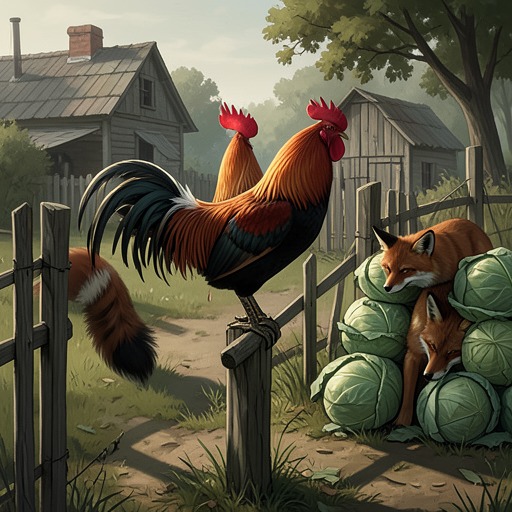
Chanticleer belongs to a widow’s rural household. Her yard is enclosed by paling and bordered by a dried-up ditch, a modest but clearly bounded space in which the rooster is kept as both property and spectacle. The enclosure gives him security, but it also establishes the confined world from which he must later be carried into the woodland. He is not merely an anonymous barnyard animal: the narrator singles him out by name and presents him as the dominant presence in the yard.
His defining distinction is his crowing. Chanticleer is described as being without peer in all the realm of crowing, and his voice is merrier than a play. The praise makes sound central to his identity: his voice announces authority, vitality, and public presence, but it also becomes the practical condition of his danger. The same act that displays his excellence gives the fox an opportunity to locate and seize him.
The fable’s animal world is granted human capacities. In those days, the narrator says, beasts and birds could speak and sing. Chanticleer therefore occupies a double position: he remains physically a cock, with a perch and wives, yet he also participates in marriage, argument, persuasion, fear, and calculated deception. This speaking-animal structure allows ordinary rural behavior to carry the weight of human social and moral conflict.
Household and Domestic Life
At the beginning of the episode, Chanticleer is on his perch with seven wives in the hall. The detail establishes both his domestic importance and his masculine self-confidence. He is surrounded by a small household rather than isolated in the landscape, and the presence of seven wives makes the later encounter with the fox part of a wider domestic drama: the threat reaches into a settled community and interrupts its apparent safety.
The yard’s enclosure and the rooster’s elevated perch create a contrast between protection and exposure. The paling and ditch separate the household from the outside world, while the perch places Chanticleer above the other animals and makes him visible. His position suggests command, but it cannot prevent an enemy who has observed the grove and learned how to exploit the household’s complacency.
Encounter with Sir Russell
The predator is a black-marked fox, described as iniquitous and sly, who has lived for three years in the nearby grove. His long residence gives the attack a sense of patience and design. He is not an accidental intruder wandering into the yard; he is an established neighboring danger, close enough to study the household and wait for the right opening.
The decisive opening comes when Chanticleer stands high upon his toes, stretches his neck, closes his eyes, and begins to crow loudly. The posture combines display and vulnerability. He heightens himself physically, shuts out immediate awareness, and gives his voice full force. At that exact moment, Sir Russell springs from hiding, grabs Chanticleer by the throat, and carries him on his back toward the woodland.
The capture is abrupt because the scene reverses the rooster’s apparent mastery in a single motion. The bird who seemed most powerful when his voice rang out is reduced to a body being transported by another creature. The fox’s grip on the throat also gives the attack a precise symbolic force: the organ of Chanticleer’s fame becomes the point through which his freedom is threatened. The celebrated voice is first silenced by force before it becomes the means of escape.
Verbal Reversal and Escape
Even while lying on the fox’s back and fearing for his life, Chanticleer does not surrender the power to speak. His escape begins when he addresses the fox and frames his thought as advice about what Sir Russell himself would do in the same situation. Rather than attacking the fox directly, he presents a verbal challenge that appeals to the predator’s pride and invites him to demonstrate superiority.
The fox’s response to that challenge creates the reversal. To speak back, he opens his mouth; the opening loosens the physical hold that had made escape impossible. Chanticleer then gets away, turning the fox’s confidence into the instrument of defeat. The outcome does not depend on greater strength. A rooster carried helplessly by a fox defeats him through timing, speech, and an understanding of how vanity governs the predator’s behavior.
This reversal gives Chanticleer a form of practical intelligence distinct from his earlier self-display. His crowing had exposed him, but his speech saves him. The episode therefore distinguishes between performance that seeks admiration and language used under pressure. Chanticleer survives only when he converts the fox’s appetite for recognition into a moment of carelessness.
Narrative Role and Significance
Chanticleer’s story is structured as a compact animal fable in which danger grows from a familiar trait: the pride associated with being admired. His superiority in crowing is genuine within the tale, but genuine excellence does not protect its possessor from deception. The fox does not overcome him by disproving his distinction; he exploits the rooster’s willingness to inhabit it publicly.
The episode also belongs to the book’s recurring concern with sudden changes in fortune. Chanticleer’s hope and pride appear to have been overturned when the fox carries him toward the woodland, but the apparent victor soon loses control. The narrative emphasizes how quickly an enemy’s triumph can become embarrassment. Capture and escape are placed close together, making reversal more important than prolonged physical struggle.
The fable’s moral pressure falls on both animals. Chanticleer’s vanity makes him susceptible to danger, while Sir Russell’s pride makes him susceptible to counter-deception. The rooster is not presented as wholly innocent, and the fox is not defeated because he lacks intelligence. Each creature possesses a recognizable strength, and each is undone when that strength becomes overconfidence. Chanticleer’s lasting significance lies in this combination of vulnerability and resourcefulness: he is the famous voice that nearly destroys its owner, then the quick speaker who turns an enemy’s boastful response into freedom.